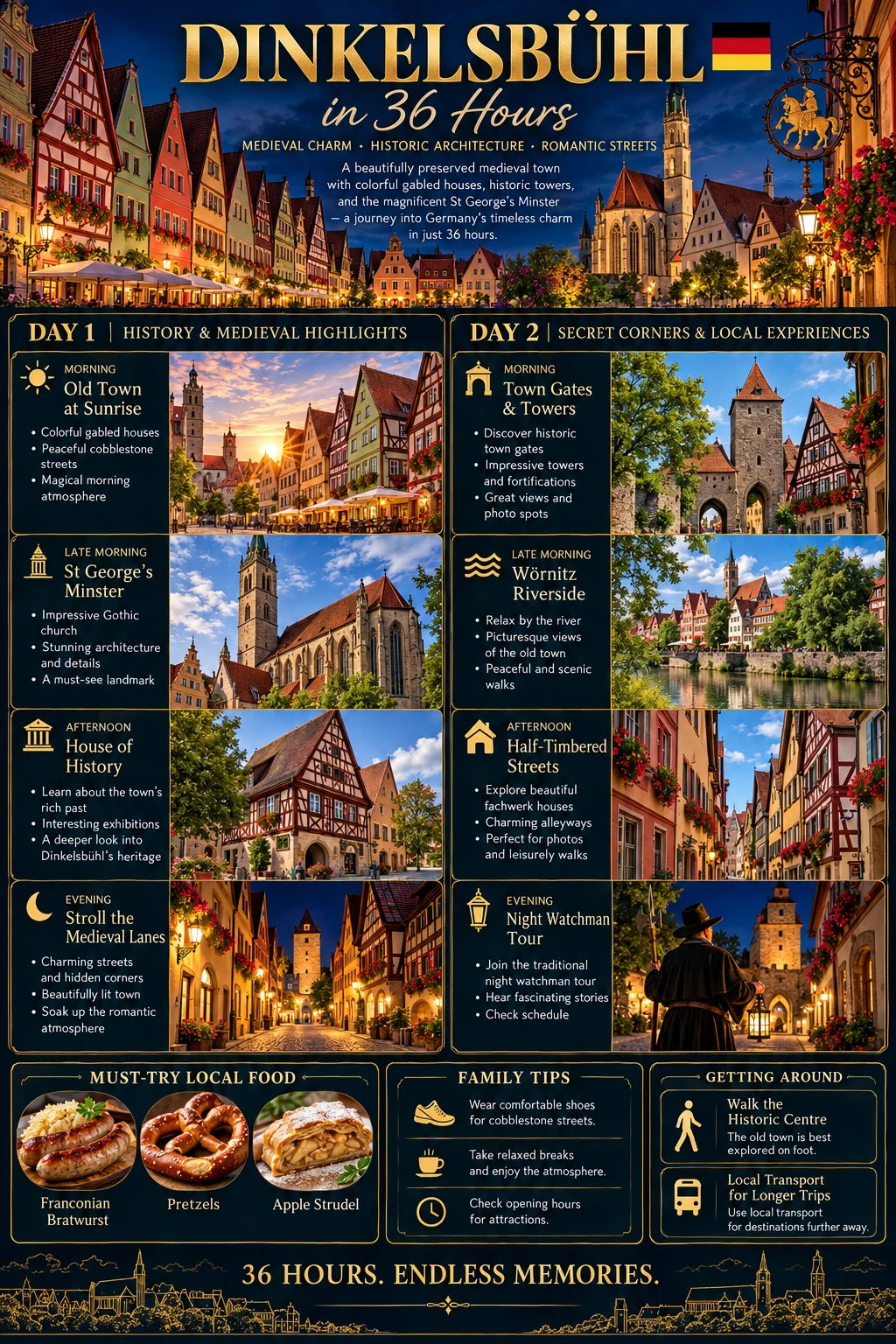
36 Hours in Dinkelsbühl: Gates, Gardens and an Evening Watchman
Research checked: 16 October 2026. Walking and visit durations are planning estimates.
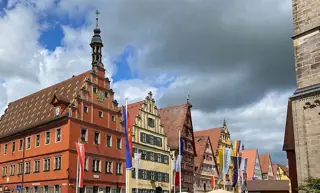
Dinkelsbühl is best enjoyed at the pace of a small town. Its appeal lies in how the pieces fit together: substantial gates, irregular streets, painted façades and a green belt just outside the defences. Staying overnight gives you the quieter edges of the day and makes the night-watchman walk possible without a late drive elsewhere. Choose accommodation inside or immediately outside the walls. The following route starts at 9am and ends around 9pm the next day, leaving space for meals, rest and the unexpected shop window.
Day 1: Find your bearings within the walls
9am–11am: Breakfast, the market streets and St George
Begin near Weinmarkt with breakfast and a short orientation walk. Resist the urge to photograph every building from the middle of the road: the old town remains a working place, and traffic rules vary by day. Look closely at rooflines and gateways as you approach St George's Minster. Inside, allow roughly 30–45 minutes to appreciate the height and rhythm of the hall church. Check the entrance notice and step aside for worship; a sightseeing timetable does not override a service.
The city's official visitor page publishes different summer and winter visiting hours for the minster. Treat the church as a morning stop rather than assuming it will remain open for an evening return. Afterwards, sit outside with a coffee and let the scale of the town become familiar. City museum and church information
11am–1pm: A guided walk, if the language suits
A guided old-town tour is a useful introduction to the town's development and religious history. The municipal tourism service currently lists daily German-language walks, with an 11am option from May through 6 January. From 7 January through April, the public tour is at 2.30pm only: use this morning for the self-guided circuit below, then move the guided tour into the afternoon and shorten the museum visit or shift it to day two. English and several other languages are offered through reserved group tours. If you want English interpretation, arrange it beforehand instead of turning up at a German tour and expecting translation.
Without a guide, make a compact circuit from the minster toward Wörnitz Gate and back through the smaller streets. Budget an hour with stops. The gate's heraldry includes spelt ears and hills, a visual reference to the town's name, and the imperial eagle. Ask children to find these details before showing them a photograph. Official tours, Wörnitz Gate
1pm–4pm: Franconian lunch and the House of History
Choose a traditional inn for lunch. Franconian sausages, seasonal dishes and a bread-based meal are sensible possibilities; vegetarians should check menus rather than assuming every historic inn offers substantial meat-free options. Keep lunch moderate if you intend a larger dinner.
Spend 75–120 minutes at the House of History in the Old Town Hall. Its focus on war and peace gives the handsome streets necessary context. The city describes children's interpretation and English audio guides, making this a stronger family option than simply adding another architectural walk. Adults and children do not need to inspect every exhibit together: agree a meeting point and a manageable pace. Follow with a break at your accommodation or a café rather than booking another museum immediately. House of History
4pm–9pm: The town's green edge and the watchman
Walk toward Rothenburger Tor and the nearby pond. This provides a different composition from the tightly framed market streets: water, towers and open sky. The city identifies the Rothenburger Weiher, Faulturm and park-keeper's house as a particularly attractive view, with the municipal park continuing beyond. Allow 45–75 minutes and return before dinner. Rothenburger Tor and park
If it fits your date, join the night watchman at St George's Minster. At verification, the city lists a 9pm German-language departure daily from May to 6 January, and Fridays and Saturdays only from 7 January through April. Verify the current schedule close to travel. Young children may prefer an earlier illuminated-street stroll; do not make a late performance the condition for a successful family day. Night-watchman schedule
Day 2: Gates without a checklist
9am–12pm: A leisurely wall-side circuit
After breakfast, trace part of the outer green belt, connecting two or three gates rather than trying to enter every tower. Allow 90 minutes for a loose circuit with benches and photographs, longer if children are walking. Choose level paths where possible; grass and unsealed sections may be wet. The aim is to understand the town's enclosure from outside, not to assume there is a continuously accessible elevated rampart walk.
Return through a different gate and compare the broad approaches with the narrow interior streets. This is a good morning for sketching, photography or a small shopping purchase because there is no distant transfer to catch.
Noon–4pm: Lunch and one optional indoor stop
Have lunch before deciding whether you want another museum. The Museum of the Third Dimension, which the city lists among its attractions, is an option for families interested in visual effects; check its own current opening calendar before committing. Otherwise, take a long bakery break and revisit the streets near Segringer Tor. A rainy afternoon need not become a forced march between closed doorways.
4pm–9pm: A final quiet circuit and dinner
Use the early evening for your favourite view, then eat before the onward journey. If your departure is earlier, simply drop this repeat walk. It is deliberately expendable, preserving the first day's essential experiences.
Three quieter worthwhile places
- Rothenburger Weiher: a water-side pause just beyond the northern gate.
- The Stadtpark beyond Rothenburger Tor: room to decompress after the streets and museum.
- The green belt near the Bleiche: a softer approach to the town's walls, best in daylight and dry conditions.
Arriving and travelling with children
There is no direct regular train service to Dinkelsbühl. The city lists bus connections from rail hubs including Crailsheim, Dombühl and Ansbach; check the complete rail-and-bus journey, particularly Sunday and evening departures. Do not plan around a presumed station in the old town. By car, park outside the walls and walk roughly 5–15 minutes to your accommodation, depending on the car park. Ask your hotel about unloading first. Official transport guidance
Cobbles can make small stroller wheels tiring. Build in playground or lawn time, carry a rain layer and book accommodation well ahead for major festivals. Winter brings short daylight and a thinner evening programme; the museum and a good lunch become the anchors. Prices are intentionally omitted, and opening calendars should be reconfirmed for the actual travel date.
Sources & travel planning
Research checked 2026-10-16. This date describes the guide’s research, not a guarantee of current conditions. Opening hours, prices, access, transport and travel advice can change. Recheck the official sources before booking and departure. Walking and journey times are planning estimates.
Found a change? Contact Only36Hours about a correction.