36 Hours in Quedlinburg: Timber Frames, Powerful Women and Modern Art
Verified: 16 October 2026. This guide incorporates the castle museum’s October 2026 reopening; older closure notices remain online.
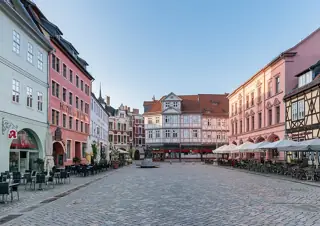
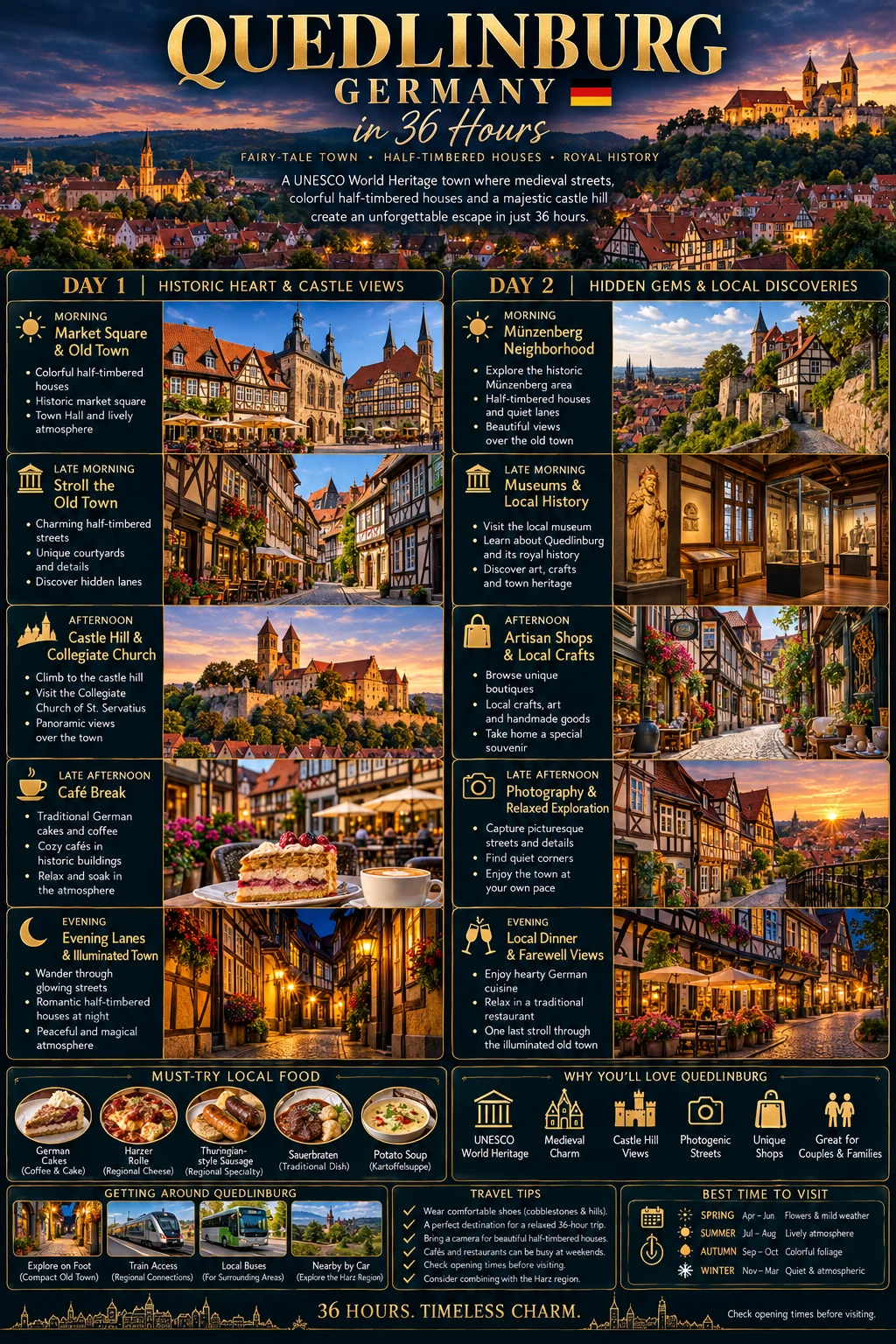
Quedlinburg’s first attraction is its street pattern: timber-framed houses lean into small squares, narrow lanes reveal another roofline, and the Stiftsberg rises above it all. But the town is more than a picturesque collection of buildings. Its collegiate foundation was a centre of female religious and political power, while a modern art museum offers a completely different way of looking at architecture. Give those stories a day and a half, with time for coffee and a garden walk between them.
Before you arrive
Stay within walking distance of the market square. From the railway station, allow roughly 15–25 minutes to central accommodation, more with bags on cobbles. Check connections through the regional journey planner linked from official arrival information. A car is useful for a longer Harz trip but unnecessary for this central itinerary; use signed parking rather than trying to drive through every old lane.
Closure days differ. The Stiftsberg museum and church normally close Monday, while Museum Lyonel Feininger closes Tuesday. For a Monday–Tuesday stay, put Feininger on Monday and the Stiftsberg on Tuesday. In winter, expect earlier closing and less daylight; do not assume summer garden and museum timetables continue unchanged.
Day 1: The town and the women above it
09:00–10:00 | Breakfast and the market square
Begin with breakfast near Markt, then walk slowly around the square. Instead of photographing every façade, choose a few houses and compare the timber patterns, doorways and upper storeys. Children can make a simple drawing of a crooked roofline or count different frame designs.
Continue towards the Stiftsberg through the older lanes, allowing 20–30 minutes with stops. The climb is part of the morning’s effort, so avoid arriving already exhausted from carrying luggage across town.
10:00–13:00 | Stiftsberg, church and reopened castle museum
The castle museum reopened in October 2026, following major restoration and a new exhibition. Its interpretation centres on the imperial women’s foundation and the women who exercised authority here. Combine a selected part of the museum with St Servatius collegiate church and its treasury, allowing time to absorb the relationship between sacred objects, political patronage and remembrance.
The church’s new exhibition connects the crypt, choir and historic treasury rooms. It is an active religious place as well as a visitor attraction, so follow any service-related restrictions. Do not rush children through every panel: choose one story or object, then pause outside. Church and treasury information.
The normal combined-site pattern is Tuesday–Sunday from 10:00, closing at 18:00 March–October and 16:00 November–February, with last admission 60 minutes earlier and holiday exceptions. Confirm the current route and any temporary restrictions through the Stiftsberg visitor page.
Access has improved inside, with lifts and ramps serving most areas, but reaching the hill remains the challenge. The operator lists a steep approach through the Zwinger or a staircase. A paid vehicle arrangement is described as requiring advance booking, with details still being completed at verification; contact the site directly rather than assuming a shuttle will be waiting. For babies, the operator recommends a carrier over a stroller. Do not confuse improved internal access with an easy street-to-door journey.
13:00–14:30 | Lunch and a slow descent
Return to the lower town for lunch. A seasonal German meal, soup or a bread-and-cheese plate works well after a long museum morning. Regional produce is a better guide than insisting every menu offer one supposed “signature” dish. Look for local cheeses, preserves or other products in the Harz tourism board’s regional-food guide.
Save room for cake later. Quedlinburg’s Vincent cheesecake bakery is one possible stop near the hill; check its current opening and expect a queue at busy times. It is a suggestion, not a reservation or a claim that every variety will be available.
14:30–17:00 | How the houses stand up
Walk towards Wordgasse and, when open, visit the Fachwerkmuseum im Ständerbau. Models explain timber construction and give the streets outside more meaning. Allow around 45–60 minutes rather than treating this compact building as a half-day museum.
Its regular season runs April–October, 10:00–17:00, closed Thursday except applicable holidays. Winter access is limited to specified Advent weekends. The building is not barrier-free, and rooms are small. On a closed day, use the same time for an exterior architecture walk and café break; the whole town supplies examples once you know what to look for. Tourism access details.
18:00–20:00 | Dinner in the centre
Book a table if visiting during Advent or a major event. Otherwise, choose somewhere close to your hotel and enjoy a short after-dinner circuit of familiar, well-lit streets. Wet cobbles and winter ice are good reasons to shorten the walk. The town’s atmosphere does not require a late night or a drive into the hills.
Day 2: A different way of seeing
10:00–12:00 | Museum Lyonel Feininger
After breakfast, visit Museum Lyonel Feininger. Its prints and paintings make a striking contrast with yesterday’s medieval and early-modern settings. Look for how an artist simplifies a building into lines, angles and light, then compare that with the timber frames outside.
The published schedule is Wednesday–Monday, 10:00–18:00, closed Tuesday. Check exhibition-installation notices before travelling. The tourism office describes the museum as barrier-free, making it a useful principal indoor option for visitors unable to manage historic stairs. Ask about current children’s activities rather than promising a workshop at a particular time. Museum overview.
12:00–14:00 | Lunch and the lower gardens
Have lunch near the foot of the Stiftsberg, then walk to the Abteigarten. The shift from compact lanes to open garden space is welcome after two museum mornings. Continue into the Brühl if weather and energy suit, taking a modest loop rather than planning a long countryside excursion. Allow around 15–25 minutes from the central lanes to the garden area.
14:00–16:30 | Brühl paths and a final café
The Abteigarten and Brühl Park connect formal axes with wooded avenues. Families can use the playground and broad paths as a proper break, with supervision near water and roads. In heavy rain or high winds, substitute a café and a short town walk. Return with time to collect luggage and reach the station comfortably.
Three quieter worthwhile places
- Abteigarten: The garden below the hill is already included and gives a different perspective on the complex above.
- Brühl Park: Continue beyond the first paths for a calmer woodland pause, without losing track of your return time.
- Münzenberg: A hilltop neighbourhood opposite the Stiftsberg, worthwhile as an alternative to the garden loop. Expect a climb and uneven surfaces. Its small monastery museum has conflicting published seasonal schedules, so confirm before planning an interior visit. Official museum listing.
Advent brings crowds as well as atmosphere: reserve accommodation early and check event dates, transport and restaurant openings. At quieter times, the reward is being able to stop in a lane and actually see how the town fits together.
Sources & travel planning
Research checked 2026-10-16. This date describes the guide’s research, not a guarantee of current conditions. Opening hours, prices, access, transport and travel advice can change. Recheck the official sources before booking and departure. Walking and journey times are planning estimates.
- quedlinburg-info.de ↗
- quedlinburg-info.de ↗
- domschatzquedlinburg.de ↗
- stiftsberg-quedlinburg.de ↗
- harzinfo.de ↗
- kaesekuchenbaeckerei.de ↗
- quedlinburg.de ↗
- quedlinburg-info.de ↗
- quedlinburg.de ↗
- quedlinburg-info.de ↗
- quedlinburg-info.de ↗
- quedlinburg-info.de ↗
Found a change? Contact Only36Hours about a correction.