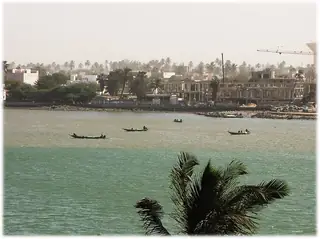
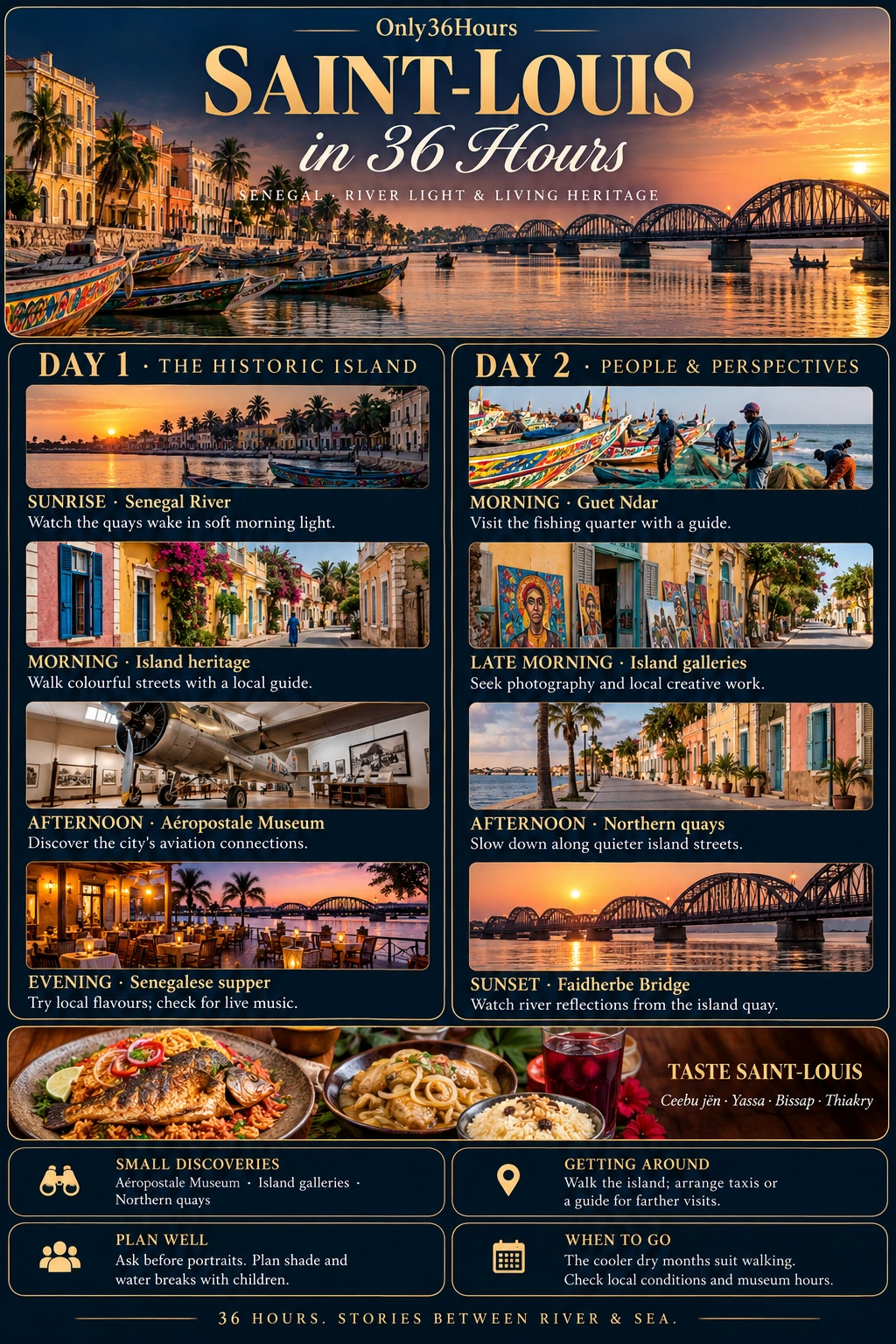
36 Hours in Saint-Louis: River-Island Streets and Senegalese Stories
Verified: 16 October 2026. Primary cultural, tourism and government sources checked on this date. Times below are planning estimates; confirm local opening and excursion arrangements directly.
Saint-Louis, also called Ndar, is a city to explore through people and stories as much as buildings. The historic island's gridded streets, courtyards and river-facing façades reflect a complex trading and colonial past, including slavery and exploitation. A good local guide can connect that history with the contemporary city rather than presenting it only as a picturesque French relic. This itinerary keeps a generous pace, with shade and rest built around the warmest hours. UNESCO's historical context
Before you go
Base yourself on the historic island for easy access to the walks and museum below. Accommodation on the Langue de Barbarie can suit a quieter stay, but requires more transfers. Arrange arrival transport with your hotel or a reputable operator, especially if coming from an airport. From Dakar or its airport, reserve most of a day for the road journey; traffic, departure point and stops make a precise universal duration misleading. Avoid planning an essential museum visit immediately after arrival.
Check current entry, health and security advice before travel. Get individual travel-health guidance in advance, including mosquito protection and any recommended preventive measures. The FCDO's Senegal advice was updated on 15 October 2026. Carry suitable insurance and identify how to obtain medical care, particularly when travelling with children. Current travel advice and health guidance
Day 1: The island and its memory
9:00–10:30 | Breakfast and a guided introduction
Start after breakfast with a locally arranged walking guide. Agree the duration, language and total price before setting off. Begin near the island end of Pont Faidherbe, then follow a manageable loop through the central streets and quays. Allow 60–90 minutes with pauses rather than attempting the entire island in the heat.
Look at balconies, shutters and courtyards from public space, and ask how buildings have changed use. The bridge is a working traffic route: use the pedestrian provision and don't step into the road for a photograph. You needn't cross it solely to complete a checklist. National tourism introduction
10:45–12:15 | CRDS museum
Continue toward the Centre de Recherche et de Documentation du Sénégal on Quai Henry Jay, allowing roughly 15–25 minutes from the central bridge area. Its museum, archives and photographic collections place the city within Senegal's wider cultural history. Ask what exhibitions are currently accessible and whether a guided explanation in your preferred language is available. Budget about an hour, leaving time for questions. CRDS museum
The institution's website currently lists public reception Monday–Friday 08:00–13:00 and 14:00–20:00, Saturday 08:00–12:00, closed Sunday. These are centre-wide hours, so confirm the museum's actual visitor session rather than assuming galleries remain open until evening. On Saturday, arrive by 10:30; on Sunday, move the museum to Monday morning and use the quay walk today. CRDS practical information
12:30–15:30 | Ceebu jën and a midday break
Lunch is a good time to try ceebu jën, the fish, rice and vegetable dish whose culinary traditions are associated with Saint-Louis's fishing communities. Ask what is being prepared that day and how spicy it is. Check for fish bones when sharing with children, and mention allergies explicitly; ingredients vary between kitchens. A restaurant meal is a better introduction than assuming a household will welcome unarranged visitors to its table. UNESCO on ceebu jën
Return to your accommodation for a rest. Use safe drinking water, carry sun protection and don't underestimate humidity. A shaded terrace and an hour off your feet make the late afternoon much more enjoyable than a continuous march between monuments.
16:00–18:00 | Quays and the northern streets
Choose a shorter second walk through the island's northern residential streets and back along a public quay. Allow 45–75 minutes and stop for tea or a cold drink at an established café. There is no need to enter every courtyard: many façades conceal private homes, and residents are not part of a staged heritage display.
Ask before photographing people, especially children, and accept a refusal without negotiation. Keep cameras discreet around transport and official buildings. With younger children or mobility limitations, replace the longer walk with a short taxi transfer and one accessible café stop, checking the entrance and toilet beforehand.
19:00 | Dinner close to your base
Choose fish, a vegetable dish or another Senegalese preparation, and ask about portions before ordering several plates. Saint-Louis is associated with jazz, but a festival reputation does not mean live music every night. Check an actual venue programme and arrange the return journey if you go out. Otherwise, dinner near your accommodation is a satisfying finish.
Day 2: Contemporary life, with one optional museum
9:00–11:30 | A respectful fishing-quarter visit
Arrange a short guided visit to Guet Ndar if local conditions are suitable. Use a taxi for the transfer if walking across town would consume the morning; allow roughly 10–20 minutes depending on your starting point and traffic. Let a guide with local connections establish where visitors are welcome that day. This is a densely used residential and working neighbourhood, not an open-air photo set.
Keep clear of boats being moved, nets, fish-processing areas and narrow access routes. Don't climb into pirogues or interrupt work. A 45–60-minute visit with explanation is enough; children may find smells, noise and crowds overwhelming, so keep an easy exit. Skip it if advised locally or if your group would be more comfortable with another island walk. Municipal introduction to Saint-Louis and Guet Ndar
12:00–15:30 | Lunch, aviation history or a courtyard pause
Return to the island for lunch. If aviation interests you, ask about the current opening of the small Jean Mermoz/Aéropostale museum before walking over. The national tourism agency identifies Saint-Louis's role in the early air-mail routes; a visit of around 45 minutes can add a different perspective. Current daily opening hours could not be confirmed, so this is optional rather than a timed anchor. If closed, use the afternoon for a café and a second look at the river-facing streets.
Collect bags with plenty of time before an onward transfer. For a long road journey, leave early enough to avoid making night driving necessary.
Three quieter worthwhile pauses
- Quai Henry Jay near the CRDS: a short daytime river-facing walk paired with the museum, avoiding obstructed or working areas.
- The northern island's residential streets: a gentle architectural circuit away from the main bridge approach; keep to public space.
- The CRDS galleries: a slower cultural counterpoint to the busy waterfront, when museum access is confirmed.
If birds are your priority
Djoudj is a separate excursion, not an extra stop after the fishing quarter. Replace Day 2 with a prearranged trip, allowing around 6–7 hours overall and confirming road conditions, park opening, boat operation and return time. The national tourism agency identifies November–April as the main migratory-bird period; this does not prove the park or boats operate on every date. Require properly fitting lifejackets, including child sizes, and ask about boarding and shade. Don't combine Djoudj with the Langue de Barbarie park in this short stay. Official parks overview
Dress modestly, avoid demonstrations, secure valuables and use arranged transport after dark. Coastal scenery is not a guarantee of safe swimming. LGBTQ+ travellers should read the specific legal and safety advice: same-sex sexual activity is criminalised, with stricter legislation introduced in 2026. FCDO safety and local-law guidance
Sources & travel planning
Research checked 2026-10-16. This date describes the guide’s research, not a guarantee of current conditions. Opening hours, prices, access, transport and travel advice can change. Recheck the official sources before booking and departure. Walking and journey times are planning estimates.
- whc.unesco.org ↗
- gov.uk ↗
- gov.uk ↗
- visitezlesenegal.com ↗
- crds.ugb.sn ↗
- crds.ugb.sn ↗
- ich.unesco.org ↗
- lavilledesaintlouis.sn ↗
- visitezlesenegal.com ↗
- gov.uk ↗
Found a change? Contact Only36Hours about a correction.