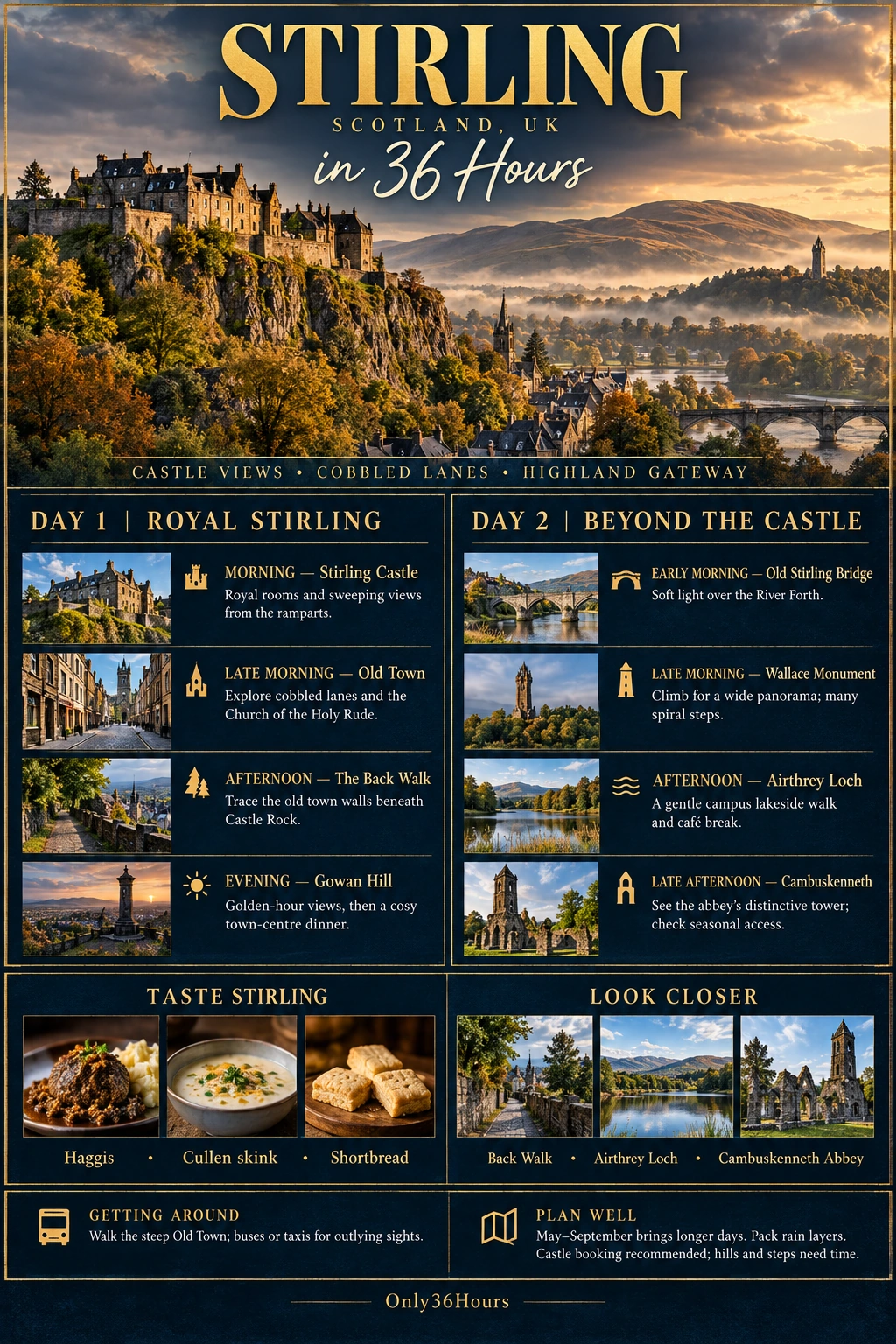
36 Hours in Stirling: Royal Rooms and Views Across the Forth
Verified: 16 October 2026. Stirling’s geography explains its history before a guide says a word. The castle rises above the city, while the Wallace Monument looks back from a separate crag across the surrounding landscape. Seeing both is achievable in 36 hours, but they require different kinds of effort. The castle is a substantial visit; the monument is a steep hill approach followed by a narrow stair climb. This itinerary gives each its own morning and uses the afternoons for streets, gardens and local history. Start with breakfast on Day 1 and finish after dinner on Day 2.
Arrival and important access notes
The railway and bus stations are near the lower city. Allow about 25–35 minutes to walk uphill to the castle, longer with luggage or frequent stops. Leave bags at your accommodation first. The castle does not provide left-luggage storage and restricts larger bags, so arriving straight from a train with a suitcase is a poor plan.
At verification, the castle visitor page says its car park is closed except to coaches and visitors requiring accessible parking. Check the notice before travelling and use current council parking or Park and Ride information. Do not assume that driving puts you at the entrance. The castle’s slopes and cobbles also merit advance access planning; ask about assistance and the routes suitable for your mobility needs.
Day 1: The castle and Old Town
9 a.m.–12:30 p.m. | Take the castle seriously
Have breakfast, then arrive for a booked morning admission after the castle opens. Give the visit around three hours rather than fitting it between other appointments. The royal rooms and wider complex are most enjoyable when you have time to compare grand spaces with the practical business of running a residence. With children, alternate detailed rooms with outdoor views and ask staff which interpretation is most suitable for their ages.
The national tourism introduction places the castle at the centre of the Stewart royal story. Use a guided introduction or official interpretation to keep the history clear rather than importing scenes from historical films. Opening and last-admission times change seasonally; Christmas closures and New Year exceptions apply. Reserve online and check the live notice again before leaving your hotel.
12:30–2 p.m. | Lunch on the way downhill
Choose a café or pub in the Old Town, with time to sit and warm up if the weather is wet. Soup and a sandwich are enough after a large breakfast; a fuller pub lunch works if you intend a light dinner. For a Scottish dish, consider haggis with its usual accompaniments if offered, or ask about a vegetarian version. Menus and preparation vary, so check ingredients and allergens directly rather than assuming the dish is suitable from its name.
2–4 p.m. | Holy Rude and the old streets
Continue to the Church of the Holy Rude and the surrounding historic streets. Its connection with James VI’s coronation gives a different perspective from the castle’s royal rooms. Visit inside only when the visitor season and services permit. Check the church visitor operator for the current date; its published 2026 visitor season runs from 25 March to 1 November, so winter interior access must not be assumed.
Walk slowly through the nearby cemetery when open, staying on paths and treating it as a burial ground rather than a playground. Wet stones and steep ground require care. If the weather deteriorates, shorten the outdoor section and have tea instead. You have already completed the day’s main attraction.
4–9 p.m. | Rest, then a city dinner
Return to your accommodation before dinner. Stay in the centre rather than adding an out-of-town excursion. Book a table if you want a particular restaurant, and ask about kitchen closing times when arriving late. The lower city is convenient for a final short walk, whereas a dark return up unfamiliar hillside paths is unnecessary.
Day 2: Wallace, then a quieter Stirling
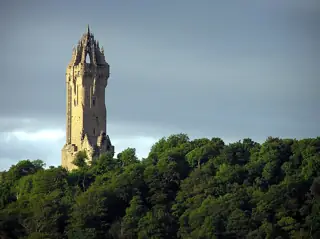
9 a.m.–noon | A monument with real physical demands
After breakfast, travel to the National Wallace Monument. Allow approximately 15–25 minutes by taxi from central Stirling, or additional time for a checked local bus connection and walking. Book your admission slot with enough margin for the hill approach.
Read the operator’s FAQ before buying: the galleries and summit require 246 narrow spiral steps, and baby carriers and large backpacks cannot be carried upstairs. Pushchairs must remain downstairs. Anyone under 16 needs an accompanying adult. Families with babies should plan to take turns, enjoy the outside, or substitute another attraction.
The hill shuttle is complimentary and can be unavailable; the walking approach includes steep sections. Allow around two hours for the complete visit. The view and interpretation reward the effort, but do not force the climb if balance, stamina or enclosed staircases are an issue. The entrance-level alternative also has shallow steps, so confirm access rather than assuming it is fully step-free.
Noon–2 p.m. | Return for lunch
Travel back to the city and have lunch before the afternoon’s quieter stops. Do not add Bannockburn as a third major historical attraction unless you replace another block entirely. Keeping one geographic focus in each half-day leaves time to absorb the stories and avoids repeated taxi journeys.
2–4 p.m. | The Smith and its garden
On an open day, visit the Stirling Smith Art Gallery and Museum for local objects and changing exhibitions. This is a useful corrective to a trip told entirely through kings and battles. Give it 60–90 minutes, then step into Ailie’s Garden if conditions allow. The museum’s visitor page confirms Wednesday–Sunday opening, wheelchair facilities, seating and baby changing; the garden follows museum hours. Monday and Tuesday visitors should move this block to Day 1 if possible or use the open-air alternative below.
4–9 p.m. | Below the castle, then dinner
If daylight and footing permit, make a short visit to the King’s Knot below castle rock. Historic Environment Scotland identifies the surviving garden earthworks and lists year-round opening. Approach by currently open streets and paths. The council reported that the Back Walk beneath the castle remained closed following rockfall concerns in August 2026, although the lower path between Clarendon Road and Victoria Road had reopened, so do not use it as an assumed connecting route; check current council information and respect barriers. Finish with an early dinner and a comfortable luggage collection.
Three quieter worthwhile places
- Ailie’s Garden: a small wildlife-minded space behind the Smith, available during museum opening.
- The King’s Knot: a chance to see the castle from below and notice the landscape around it.
- Holy Rude’s cemetery paths: a reflective stop near the Old Town’s main sights, weather and access permitting.
Bring waterproof layers and grippy footwear. Winter daylight makes an early afternoon outdoor visit preferable to an evening walk. The best version of Stirling is not the one with the most staircases completed, but the one whose pace suits everyone travelling.
Sources & travel planning
Research checked 2026-10-16. This date describes the guide’s research, not a guarantee of current conditions. Opening hours, prices, access, transport and travel advice can change. Recheck the official sources before booking and departure. Walking and journey times are planning estimates.
- historicenvironment.scot ↗
- visitscotland.com ↗
- churchoftheholyrude.co.uk ↗
- nationalwallacemonument.com ↗
- smithmuseum.scot ↗
- historicenvironment.scot ↗
- stirling.gov.uk ↗
Found a change? Contact Only36Hours about a correction.