36 Hours in Stralsund: Brick Gothic and the Northern Seas
Verified: 16 October 2026. Stralsund is a maritime city whose best views work in both directions: toward the water from the harbour, and back toward the brick churches and gables from its edge. The old town is compact, but its marine museums are substantial visits. This itinerary pairs a proper morning at OZEANEUM with enough time to understand the Hanseatic streets around it. A second museum is a choice, not a requirement. The plan begins at breakfast and ends with dinner the following evening, using one central overnight stay.
Getting here and choosing a base
From Stralsund Hauptbahnhof, allow approximately 20–30 minutes to walk to Alter Markt and another 10–15 minutes toward the harbour, depending on your route. With luggage, a local bus or taxi can make the arrival easier. Stay inside or close to the old town so you can return for a break without a complicated connection. Most sightseeing legs are 5–15 minutes on foot. Cobbles and kerbs mean that short distances are not automatically easy with a wheelchair or stroller.
The tourism office’s practical FAQ is useful for orienting yourself and choosing a guided walk. Drivers should park once outside the tightest central streets. Keep the 36 hours for Stralsund rather than adding Rügen or Hiddensee simply because they are nearby; those excursions deserve their own transport and weather planning.
Day 1: Read the city in brick
9–11 a.m. | Breakfast and Alter Markt
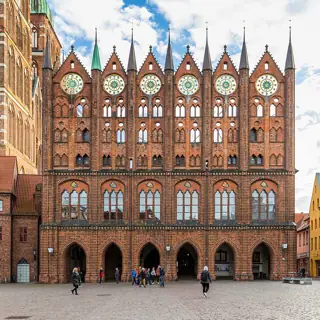
Start around Alter Markt, with breakfast before a slow look at the Rathaus façade and St. Nikolai. The combination of civic and religious architecture gives an immediate sense of the town’s former ambition. Look at the shapes and openings in the brickwork rather than moving on after one photograph. With children, compare the silhouette of the town hall with a church tower: which details are decorative and which seem structural?
The Rathaus remains a working administrative building. The tourism office explicitly says its offices are not open for general sightseeing, so do not build the morning around wandering inside. Church visits depend on opening and worship; enter quietly when permitted and accept an exterior visit if services are under way.
11 a.m.–12:30 p.m. | Understand the World Heritage designation
Visit the municipal World Heritage exhibition in the Olthofsches Palais on Ossenreyerstraße. It gives the townscape a useful frame before you explore farther. Allow 45–75 minutes, adjusting for the opening calendar; the regular November–March schedule is Monday–Saturday, with Sundays closed. On a winter Sunday, substitute an exterior old-town walk and use the museums below for indoor time. Families can ask about the courtyard’s child-oriented city-plan activity when available rather than promising it in advance.
Continue a little way along the shopping streets afterward. This is a chance to see how historic buildings accommodate an ordinary working city, not just monuments. Leave time for looking into shops and choosing a bakery without needing to make every stop part of a prescribed route.
12:30–2 p.m. | Lunch with a maritime accent
Head toward the harbour for a fish roll, smoked fish or a seated seafood lunch. Check what is fresh and available that day, and ask about bones when feeding younger children. A warm meal may be more welcome than an exposed outdoor snack in Baltic wind. The regional rail operator’s visitor guide highlights fish boats and harbour food as part of a Stralsund visit; individual vendors’ opening remains seasonal and weather-dependent.
2–4:30 p.m. | Harbour, then Heilgeistkloster
Take a gentle walk along the harbour, watching boats from public areas and keeping clear of working berths. The waterfront can feel noticeably colder than the streets behind it. Keep children away from unguarded edges and shorten the walk if the wind makes it unpleasant.
Turn back into the old town through the area around Heilgeistkloster. The tourism office’s description explains its origins as a hospital complex. Its small-scale passages offer a contrast with Alter Markt’s grand architecture. Some spaces are residential: stay on public routes, avoid blocking doorways and keep your voice low. An open church is a bonus rather than a promised interior visit.
4:30–9 p.m. | Rest and a central dinner
Return to your accommodation before dinner. Choose a restaurant in the old town and reserve if travelling on a busy weekend. A short evening loop around the illuminated façades is enough; there is no need to cross every part of the centre again. Check kitchen hours, especially outside summer, rather than assuming the harbour’s daytime food stalls will provide a late meal.
Day 2: A morning beneath the sea
9:30 a.m.–1 p.m. | OZEANEUM without rushing
After breakfast, make OZEANEUM the main event. Book a timed entry and allow around three hours for the aquariums and exhibitions. The northern-seas focus makes the visit more meaningful if you take time to notice habitats rather than simply finding the largest animal. With children, build in sitting breaks and accept that one absorbing tank can be better than a complete checklist.
The operator’s current visitor page confirms daily opening, with longer hours only in July and August. It closes on 24 December and shortens opening on 31 December. The ticket desk closes before the building, so a late arrival is not a sensible substitute for this morning block. Review the operator’s access and visitor guidance when booking if lifts, assistance or sensory needs matter to your group.
1–2:30 p.m. | Lunch and a genuine choice
Have lunch before deciding what to do next. Marine enthusiasts can visit MEERESMUSEUM in the old town; everyone else can stay outdoors or explore more architecture. Buying a combination ticket is worthwhile only if you actually want both substantial visits. Do not add the distant NATUREUM merely to use the ticket.
2:30–5 p.m. | Another museum or the quieter edge
MEERESMUSEUM is open again, despite older brochures describing reconstruction closure. Its current operator page provides live visitor information and the same major Christmas exceptions. Allow at least two hours and check the day’s closing time before lunch runs long.
For a lighter afternoon, walk toward the lanes around Johanniskloster and the Knieperteich edge instead. Interior monastery access and special tours require separate confirmation; the surrounding public streets are the point of this alternative. Choose a short out-and-back walk, then stop for coffee.
Three quieter worthwhile places
- Heilgeistkloster’s public passages: intimate streetscape away from the largest façades.
- The lanes near Johanniskloster: rewarding for a slow architectural walk without assuming interior admission.
- Knieperteich’s accessible public edges: a green change from the harbour, best enjoyed in daylight and good footing.
Finish with dinner around 6–8 p.m., leaving time to collect luggage if departing. Spring and autumn can be excellent for a city-focused stay, but rain and wind should determine your museum order. Check current local transport links through the operator’s arrival section rather than using an old bus number.
Sources & travel planning
Research checked 2026-10-16. This date describes the guide’s research, not a guarantee of current conditions. Opening hours, prices, access, transport and travel advice can change. Recheck the official sources before booking and departure. Walking and journey times are planning estimates.
- stralsundtourismus.de ↗
- stralsund.de ↗
- odeg.de ↗
- stralsundtourismus.de ↗
- deutsches-meeresmuseum.de ↗
- deutsches-meeresmuseum.de ↗
Found a change? Contact Only36Hours about a correction.