36 Hours in Sucre: Independence, Textiles and Whitewashed Streets
Verified: 16 October 2026. Sucre is a city for measured walking: whitewashed streets, shaded courtyards and a central square that invites you to sit rather than move on immediately. Its political history is essential, but so are the living textile traditions represented at ASUR. This itinerary keeps both in view, with one uphill afternoon and generous breaks. It begins after breakfast on Day 1 and ends with dinner on Day 2. Arrive beforehand if possible; a long overnight bus journey should not be followed by an ambitious sightseeing morning.
Important conditions before booking
Check current official travel advice for Bolivia and your own government’s guidance. At verification, the FCDO reports a national State of Emergency, possible roadblocks and disruption. Its specific advice against all but essential travel concerns the Chapare region, not Sucre as a blanket designation, but journeys elsewhere can still be affected. Never try to cross a roadblock. Keep transport flexible and reconfirm airport transfers locally.
Sucre’s altitude also warrants a gentle start. Read the official travel-health advice, particularly if travelling with children or a health condition. This is not a route for proving how quickly you can climb a hill. If you feel unwell, stop sightseeing and seek appropriate local medical advice.
Day 1: The country’s founding story
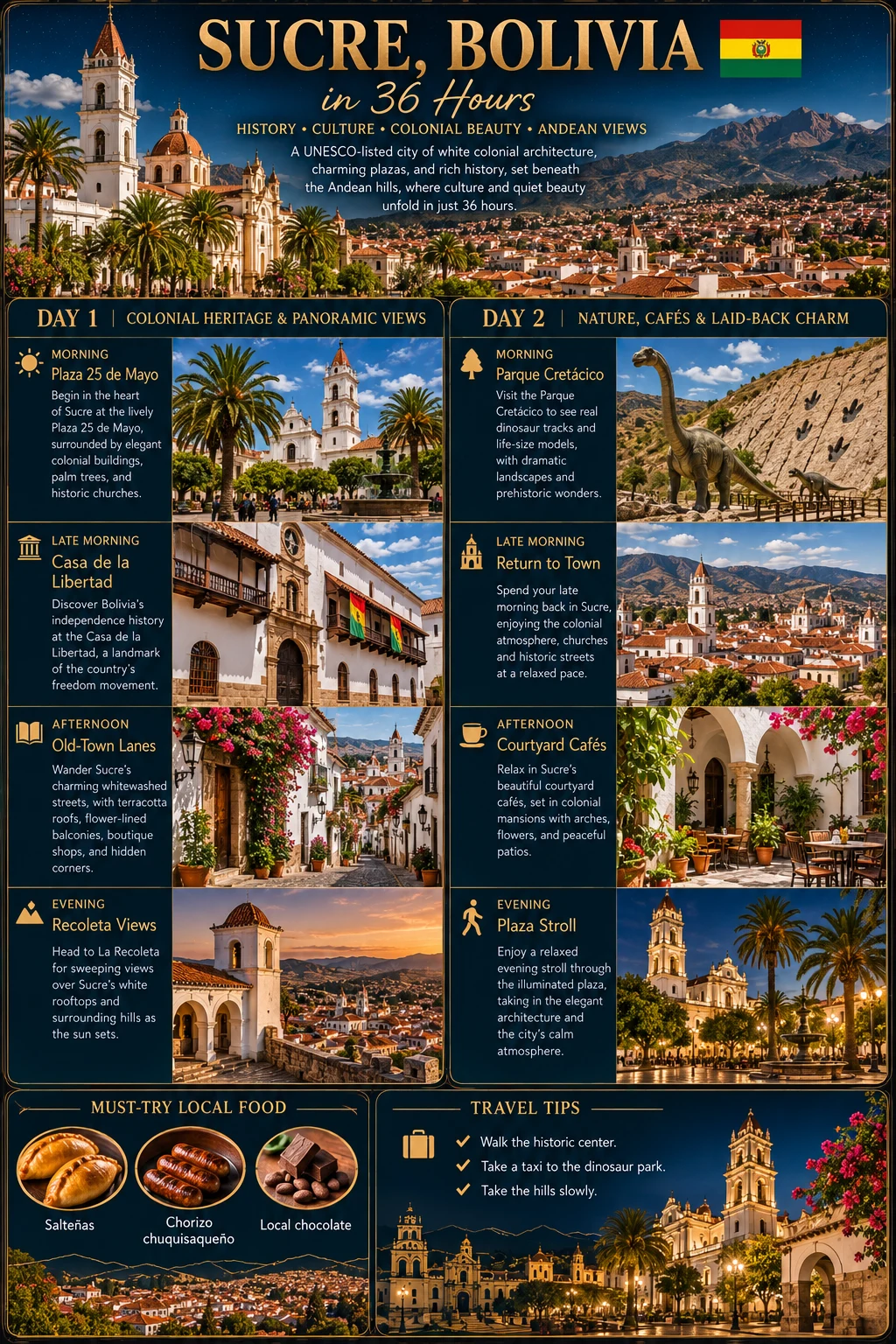
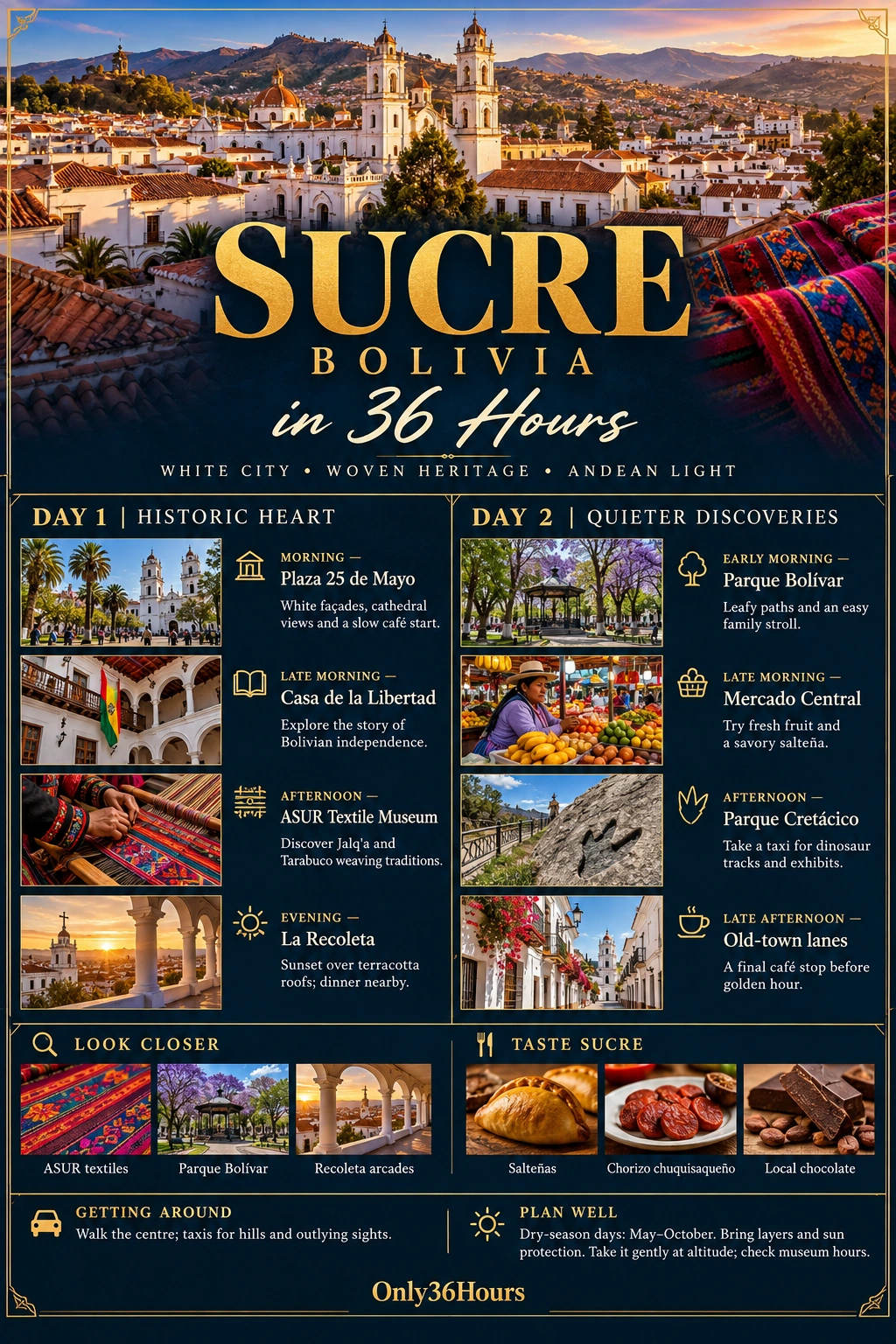
9–10 a.m. | Plaza 25 de Mayo
Leave luggage at your accommodation and begin around Plaza 25 de Mayo. A central hotel reduces the need for taxis and makes afternoon rest practical. Have breakfast or a second coffee, then make a slow circuit of the square. Look at the surrounding façades and the relationship between civic, religious and social spaces.
Most central legs take around 5–15 minutes on foot, but allow longer for uneven pavements, crossings and altitude. Keep valuables secure and use accommodation-recommended transport when needed. The official safety guidance advises established taxi companies and particular caution around demonstrations and transport disruption.
10 a.m.–noon | Casa de la Libertad
Visit Casa de la Libertad before lunch, particularly on a weekend. Its rooms connect the city to Bolivia’s independence and subsequent political history. Ask about the next guided visit in a language you understand; a well-explained hour is more useful than photographing every room without context. Families can choose one question to follow, such as how a new country represents itself through documents and symbols.
The museum’s own schedule gives shorter Saturday and Sunday opening, public-holiday closure and last admission an hour before closing. This is why the visit belongs in the morning. Do not rely on the older municipal brochure’s different hours. Check the current programme and book a group visit separately if appropriate.
Noon–2 p.m. | Lunch and a short market look
Try a salteña as a late-morning snack if you find a freshly prepared one, then have a modest lunch rather than treating the pastry as a complete restaurant meal. Regional menus may include chorizo chuquisaqueño or mondongo; ask what is in the dish and how spicy it is. Choose busy establishments handling food carefully and drinking water you know is safe. Children may prefer a simple cooked meal before another outing.
A brief market visit offers a different kind of city life, but keep it purposeful: look, ask politely before taking photographs and buy something you actually want. Avoid blocking working stalls for a photo session. Return to your hotel afterward for a proper break.
3–5 p.m. | An architectural afternoon without a forced climb
Walk a small circuit of the central streets, using the municipality’s visitor guide for orientation. Choose one confirmed church or courtyard visit if available. San Felipe Neri is often of interest for its architecture and terraces, but do not assume its school and religious spaces are open all day; obtain current visitor arrangements locally before walking over.
If access is unavailable, the street-level architecture is a worthwhile afternoon in itself. Save the Recoleta climb for tomorrow, when you have had more time to settle into the altitude. A café stop belongs in the plan, not in the category of time wasted.
6–9 p.m. | Dinner close to your base
Have dinner in the centre and arrange a taxi if returning through unfamiliar streets after dark. Keep the evening simple. Reconfirm the next morning’s museum hours and avoid committing to an early intercity departure immediately after this short stay when road conditions remain uncertain.
Day 2: Textiles and the hillside
9–11:30 a.m. | ASUR, with time to look closely
After breakfast, take an established taxi uphill to the Recoleta area, allowing roughly 10–20 minutes including pickup. Fit walkers can walk in about 25–40 minutes from the central square, but the slope and altitude make the taxi a sensible option rather than a concession.
Visit the ASUR Indigenous Art Museum. Textiles reward close attention: colour, repeated motifs and technique tell stories that a quick souvenir-shop glance cannot. Ask staff about interpretation and any demonstration actually taking place. Do not promise children that a weaver will be working during every visit.
The foundation’s visitor page lists Monday–Saturday sessions with a midday closure; no ordinary Sunday session is listed. Schedule this morning on an open day and exchange it with Day 1 if necessary. Confirm accessibility before visiting, as the historic setting and hillside should not be assumed step-free.
11:30 a.m.–2 p.m. | Recoleta and lunch
Spend time in the public square and viewpoint area around Recoleta, then choose lunch nearby or return to the centre. The view is a chance to understand the city’s scale, not a reason to approach unguarded edges or climb on walls. Keep the walk short in strong sun or rain. Religious interiors require their own opening confirmation.
2–5 p.m. | Choose a gentle finish or a dinosaur alternative
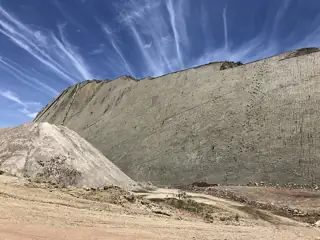
The default afternoon is deliberately light: a café, a return to a favourite central street and any missed confirmed museum. Families especially interested in dinosaurs can instead replace the entire morning or afternoon with Parque Cretácico, arranging transport and checking current opening directly. The municipality describes its palaeontological visitor experience. Do not assume close access to the footprint cliff is included or available to every age group; clarify guided access and conditions before booking. Allow a half-day including transport rather than squeezing it between two museums.
Three quieter worthwhile pauses
- Recoleta’s public square outside busy tour arrivals: a place to sit after the uphill journey.
- ASUR’s exhibition rooms: quieter contemplation of living cultural traditions, subject to opening days.
- A short side-street circuit off Plaza 25 de Mayo: choose occupied public streets and enjoy the architecture without entering private courtyards.
Finish with an early dinner and ample luggage-collection time. If roadblocks, illness or weather interrupt the plan, drop the optional excursion first. Sucre’s strongest short visit is a coherent city stay with space to breathe.
Sources & travel planning
Research checked 2026-10-16. This date describes the guide’s research, not a guarantee of current conditions. Opening hours, prices, access, transport and travel advice can change. Recheck the official sources before booking and departure. Walking and journey times are planning estimates.
- gov.uk ↗
- travelhealthpro.org.uk ↗
- gov.uk ↗
- casadelalibertad.org.bo ↗
- sucre.bo ↗
- sucre.bo ↗
- fundacionasur.org.bo ↗
- sucre.bo ↗
Found a change? Contact Only36Hours about a correction.