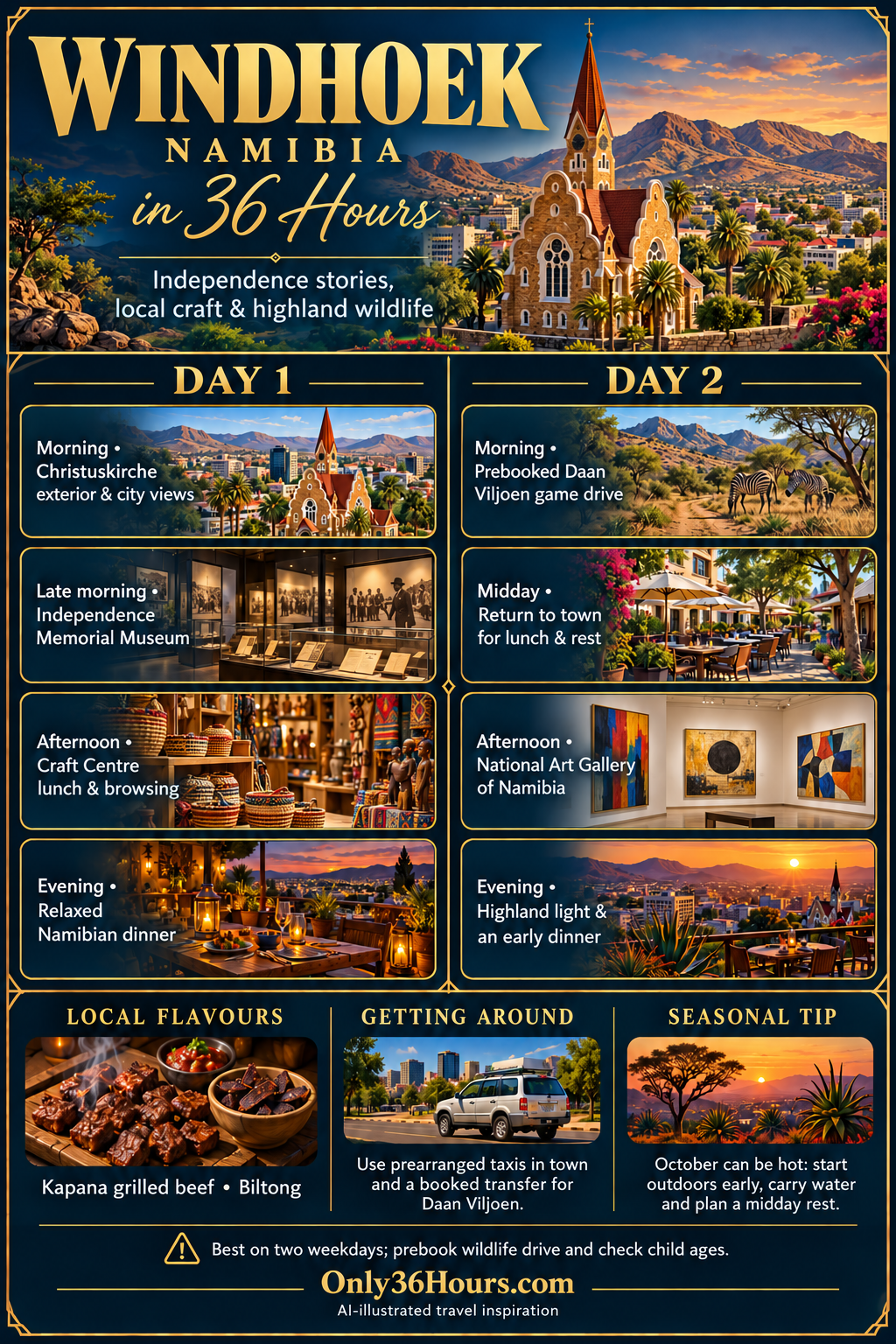
36 Hours in Windhoek: Independence Stories, Local Craft and Highland Light
Verified: 18 October 2026.
Windhoek deserves time before the long drive into Namibia’s landscapes. Around Robert Mugabe Avenue, a colonial-era church stands near a museum devoted to anti-colonial resistance. Elsewhere, craft shops and contemporary art offer ways into a country that cannot be understood through wildlife alone. Namibia became independent on 21 March 1990; the United Nations’ historical outline provides useful background before visiting the capital’s memorials.
Plan this as two weekdays, with one overnight stay, from approximately 09:00 to the following evening. Those 36 hours include generous breaks and rest. With children, a shorter museum visit and a properly arranged wildlife drive will be more rewarding than trying to tick off every landmark. This is a researched itinerary, not a claim of firsthand experience or guaranteed daily access.
Before you arrive
Book a central hotel or guesthouse that can help arrange reliable transport. Hosea Kutako International Airport is about 45 kilometres east of Windhoek, so landing time is not city-arrival time. Allow separately for immigration, baggage and the road transfer. Agree the pickup, total fare, luggage capacity and any child-seat requirements before travelling; do the same for the return journey.
Use short daytime walks where appropriate and prearranged rides between dispersed stops. Avoid building an evening around a long walk back to your accommodation. Keep valuables discreet and ask your host about the current conditions along the route you intend to take. A vehicle booked for the wildlife outing does not automatically include airport or city transfers.
Check the Independence Memorial Museum before departure. The Museums Association of Namibia currently lists weekday opening and weekend closure. Other visitor listings have differed, so a weekday plan is the sounder starting point. Confirm special closures and any guided visit directly, rather than relying on a timetable copied into a travel itinerary.
Day one: history, making and a slower lunch
09:00–10:00 | Christuskirche and the civic skyline
Begin with the exterior of Christuskirche, approaching carefully through the traffic environment. The city’s history page identifies Gottlieb Redecker as its architect and records its consecration in 1910. Its stone walls and red roof make an obvious orientation point, but the building is also a prompt to ask whose history is represented in the cityscape.
Keep the church interior conditional on actual access and worship arrangements. Do not assume neighbouring government grounds or gardens are freely open. A brief exterior stop is sufficient before moving to the museum, with time for water and a shaded pause.
10:00–12:00 | Independence Memorial Museum
The museum’s three galleries cover anti-colonial resistance and the armed liberation struggle. Read the exhibits as a national account of independence, taking time over the human consequences as well as the political chronology. Parents should preview material where possible: violence, oppression and conflict may require selective viewing and explanation.
Give yourself permission to leave a gallery early if younger children have reached their limit. One carefully discussed photograph or object can be more meaningful than rushing through every display. Do not promise a rooftop meal or viewpoint as part of the visit without checking that facility separately.
12:30–15:00 | Namibia Craft Centre
Take a ride or a manageable daytime walk to the Namibia Craft Centre on Tal Street, in the Old Breweries Complex. The operator describes a range of independent craft enterprises, an exhibition space and the Craft Bistro. Make this the day’s deliberately long lunch stop.
After eating, browse a few stalls rather than treating the whole centre as a souvenir sprint. Ask about a basket’s material, a textile’s maker or the origin of a piece of jewellery. Different items represent different communities and businesses; no single purchase stands for all Namibian culture. Ask before photographing people or individual work, and check export or airline restrictions before buying natural materials.
15:00–evening | Food, rest and an optional guided neighbourhood visit
Return to your accommodation for a break. If food culture is a priority and the family still has energy, arrange a locally guided visit that includes a kapana stop in Katutura, with the operator confirming the exact market and return transport. The Namibia Tourism Board’s food introduction describes kapana as beef grilled over an open flame and also introduces biltong, dried seasoned meat.
Treat this as an optional food visit, not an invitation to photograph residents or enter homes. Ask about ingredients, choose food cooked and served appropriately, and keep a simple alternative for children or anyone with dietary requirements. Otherwise, have an early Namibian dinner near your accommodation and save energy for the morning.
Day two: the highlands and contemporary Namibia
Early morning–12:00 | A booked Daan Viljoen outing
Reserve a guided game drive and transport before the trip. Daan Viljoen’s operator advertises guided drives and birdwatching in the park west of Windhoek. Confirm whether your booking admits day visitors, the meeting point, duration, child ages, vehicle boarding requirements and what happens if weather or availability changes. This itinerary assumes a confirmed morning departure, not a walk-up service.
The attraction is the highland setting and the possibility of watching free-ranging wildlife. Sightings are never guaranteed. Follow the guide’s directions, keep a respectful distance and do not feed animals. Bring water, sun protection and an extra layer for the early start. Do not add an independent trail simply because time remains; terrain, heat and the group’s fitness matter.
12:30–16:30 | Lunch, rest and the National Art Gallery
Return to Windhoek for lunch and a quiet interval, then visit the National Art Gallery of Namibia. Its own current indexed visitor information identifies its role in supporting Namibian art and artists, with weekday opening, a shorter Saturday and Sunday closure. Check the current exhibition and hours directly before setting out; a particular work or temporary show is not guaranteed.
Choose a few works to discuss rather than asking children to absorb an entire exhibition. Notice how contemporary artists complicate the impressions formed in yesterday’s history museum. If the gallery is unavailable, revisit the Craft Centre’s exhibition area if open, or simply retain a relaxed afternoon instead of inventing another admission.
Three quieter pauses
- The Craft Bistro: a seated break within the craft complex, especially outside the lunch rush.
- The National Art Gallery: an indoor, slower-looking alternative to a busy sightseeing sequence; events can change the atmosphere.
- Daan Viljoen’s bush setting: a change of pace beyond the city, accessible through your confirmed outing rather than an assumed unrestricted visit.
Practical and seasonal notes
The tourism board’s climate guidance describes hot summers, summer rainfall and much colder winter nights. Start outdoor activities early, carry water and avoid treating midday heat as a reason to hurry. Check lifts, toilets, vehicle access and walking surfaces with individual venues if mobility needs affect the route. End with an early dinner and a generous onward-travel buffer. This short stay is for Windhoek and its nearby highlands; distant dunes and major national parks belong to a separate journey.
Sources & travel planning
Research checked 2026-10-18. This date describes the guide’s research, not a guarantee of current conditions. Opening hours, prices, access, transport and travel advice can change. Recheck the official sources before booking and departure. Walking and journey times are planning estimates.
- namibia.un.org ↗
- airports.com.na ↗
- museums.com.na ↗
- windhoekcc.org.na ↗
- namibiacraftcentre.com ↗
- visitnamibia.com.na ↗
- sunkarros.com ↗
- nagn.org.na ↗
- visitnamibia.com.na ↗
Found a change? Contact Only36Hours about a correction.